
Just do the reading
The most important lesson from my 20's
One of the most important lessons I’ve learned as a writer was articulated by two considerably more-famous writers.
Ezra Klein on David Perell’s podcast in 2025:
As a young person going out into the world, you would not believe how many shortcuts your elders are taking. When I got into journalism, I realized that simply reading the Congressional Budget Office reports, which aren’t complicated and usually aren’t more than 30 pages, was a huge advantage. People were just reading the executive summaries, if that.
Jacob Geller, in a 2025 talk on how he does research for his excellent video essays:
There are so many online articles that reference one line from a book. And when you read enough of them, you can tell that it’s really just writers having read other online articles that reference this one fact. And so they share the one fact around like it’s the only thing in the book. And then, if you go to that book, you realize “Oh my gosh! There’s an entire world that the author wrote about this subject!”
Klein and Geller are just giving away the secret to my success, but I think it’s worth describing other shapes that this observation can take, because a lot of the reason people walk by $20 bills on the street is that they don’t recognize them on sight.
My day job
In the 8 years I spent writing for YouTube channels like Game Theory and Food Theory, a common refrain that made its way into many scripts was, “when you sit down and actually do the research…”
We were making a highly edited show with a >1 week turnaround, which is downright glacial by YouTube standards. On a platform full of people who can talk into a webcam for 20 minutes and then hit “upload,” we knew we couldn’t compete on speed, so we had to find a new angle on the “current story” that no one had covered yet.
How? A lot of the time, I just sat down and actually read the documents.
In August 2020, one of the biggest headlines in the video game world was Fortnite getting removed from the Apple App Store and Google Play Store (and the ensuing lawsuit).
When doing research for this episode, I found that “everyone” was talking about this story, from CBS to The Verge to The BBC to Techcrunch to Wired to Bloomberg, and dozens of medium-to-large video game outlets and YouTube channels. Since so many reporters’ eyes were already on this story, what more could we possibly have to add?
But when I sat down to actually read the complaint that Epic had filed, I found information that none of the dozens of competing outlets had covered. Most notably, Epic wanted to launch their own competing app store on iOS and Android, just like they’d launched the Epic Games Store on PC to compete with Steam. That seemed like a pretty big deal, so we made a video and it got several million views.
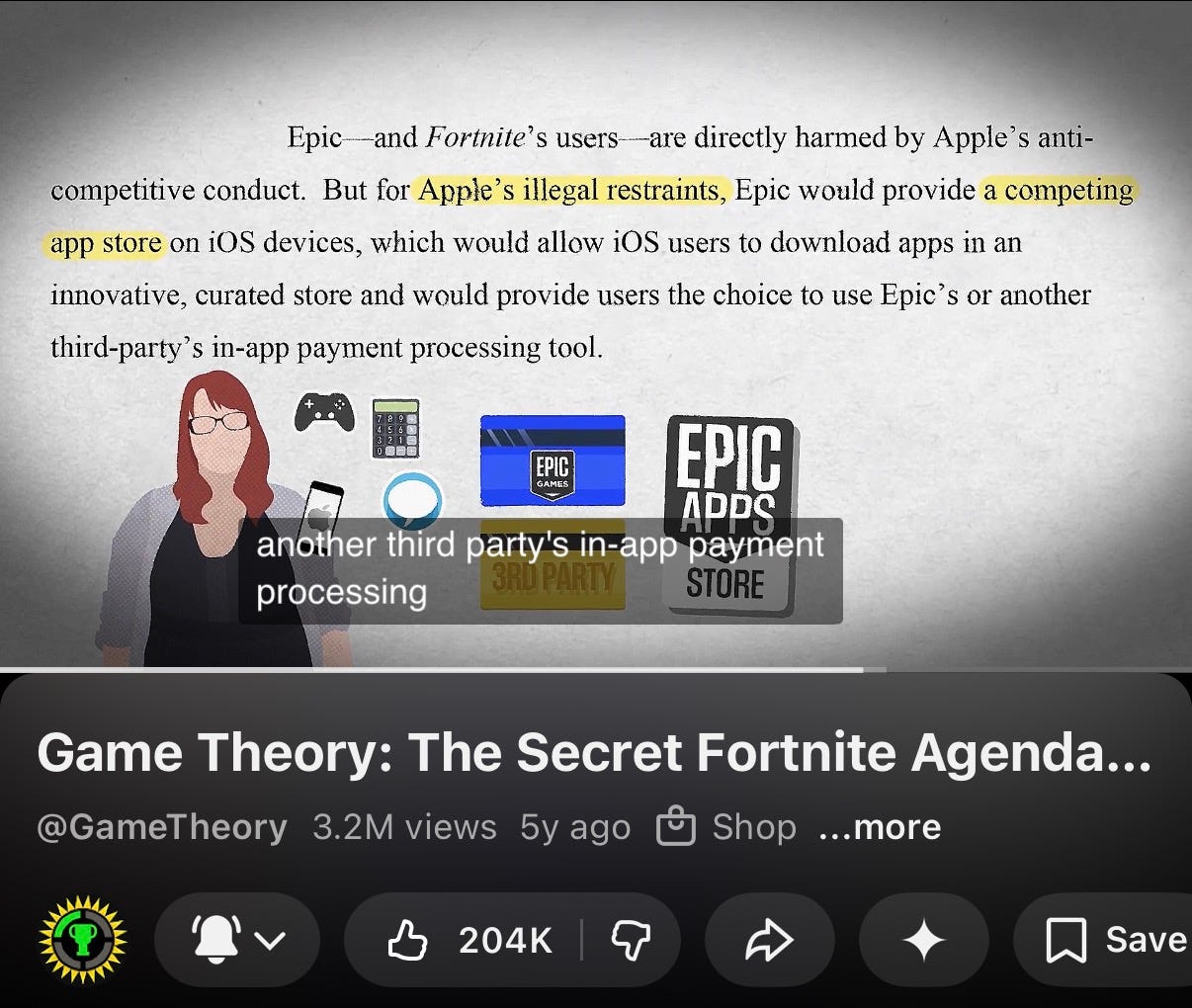
The “new angle” wasn’t hard to find; it was written in plain English in the legal filing, the same legal document that many of the news stories had linked to in their coverage. But even with so many covering the “same story,” it seemed like a lot of these news stories were just regurgitating the same information, all reading from the same press releases.
I found myself questioning whether any of the people reporting or commenting on Epic’s legal filing had actually sat down to read the same 60 page PDF I had read. One would think that if you were going to report on this lawsuit, the table stakes for that assignment would be “actually read the lawsuit.” And yet!
The world is full of myths waiting to be debunked
This is something that I did repeatedly throughout my career with Theorist; it became a recurring theme on Food Theory where I served as creative director back in 2022.
For example, there’s an evergreen myth about how Crystal Pepsi was supposedly destroyed by Coke releasing an intentionally bad-tasting soft drink, Tab Clear, what one Coca-Cola executive describe as a “kamikaze” on the clear soda market.
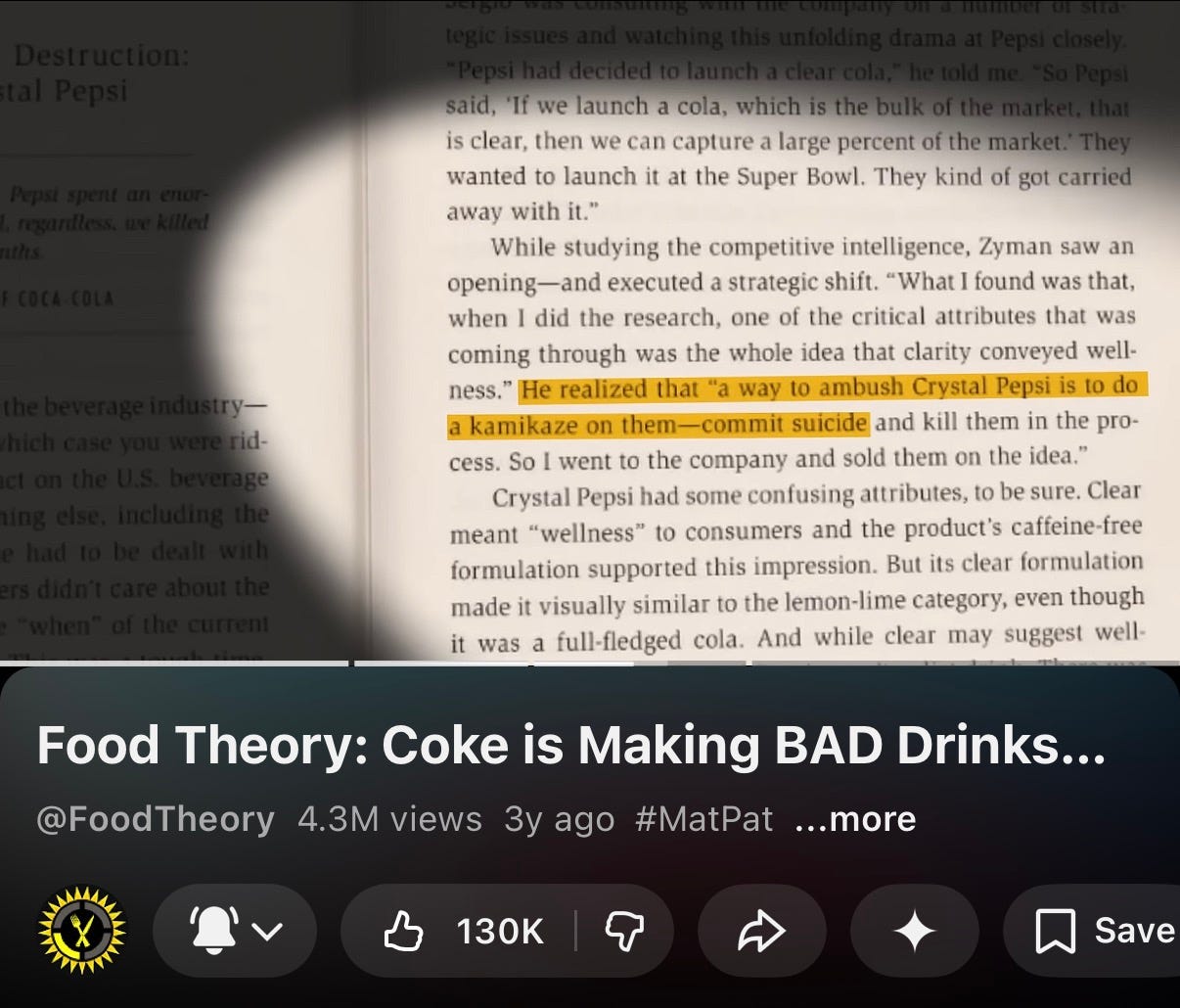
“Coca-Cola intentionally released a bad product to torpedo their competitor” is exactly the kind of story that’s too good to fact-check. But when read the source of the original claims, I quickly discovered that 1) the source was just one guy asking us to take him at his word, and 2) several of his claims were in conflict with each other, or in conflict with publicly available evidence. Just because it’s printed in a book doesn’t mean it’s true or even logically possible!
We got to make a video about how this oft-repeated “story” emerged only because a specific Coca-Cola executive wanted to spin one of his many creative failures as a secretly galaxy-brained success story.
Headlines often mischaracterize the facts
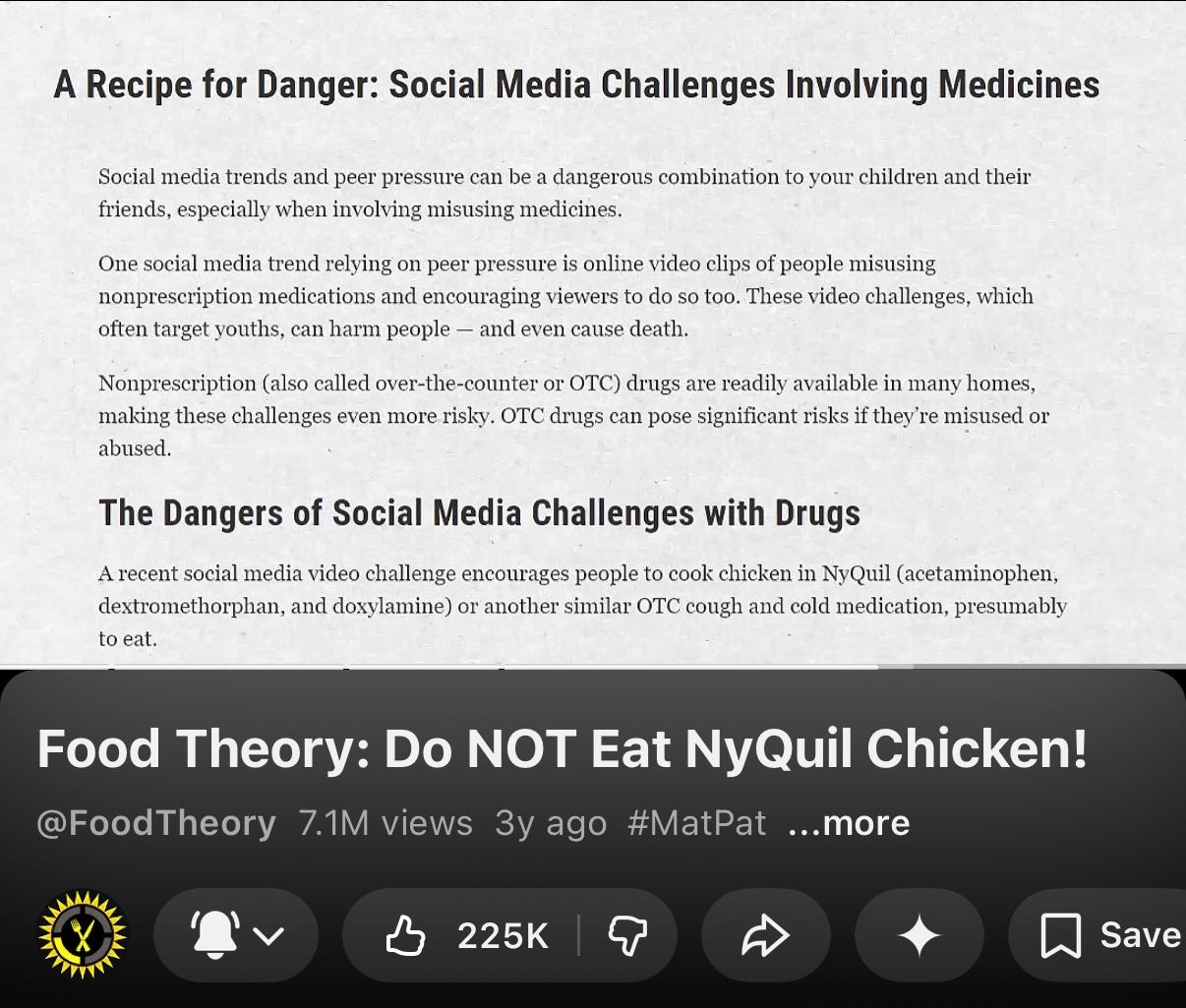
Also in 2022, a bunch of news outlets started reporting that “NyQuil Chicken” was a worrying trend. I dug into the “source” of this information, which was an FDA consumer update. And, upon actually reading directly from the source, I found that nearly all of the reporting was mischaracterizing the FDA’s statement, and so we did a story about how “the media is wrong about NyQuil Chicken.”
The efficient market hypothesis tells you that if there was really free alpha, someone would have found it by now. But lived experience has taught me that there are in fact many free $20 bills lying around, waiting for someone to pick them up!
Just do the reading
The advice of “just do the reading” isn’t limited to just writers looking for a fresh scoop:
Read the actual study
When you see a headline that seems implausible, don’t update your beliefs right away. If it’s worth updating on, it’s worth taking the time to click through and see if it’s a correlational study of 12 people over 2 weeks. It’s good to look at the methodology, but sometimes you don’t even even need to read past the abstract to discover that a headline misled you.
Read the syllabus
If you want to get a good grade in your undergraduate course, read the document that the professor hands out at the beginning of the semester explaining how to get a good grade in their class. Professors literally beg students to do this!
Read the acknowledgments
If you are a fantasy novelist trying to get a book deal with Tor, go to the bookstore and find all the books published by Tor, then find the ones in your specific sub-genre and flip to the “acknowledgments” at the end of the book, where most authors will thank their agent. Write those names down. You now have a list of agents who 1) represent books like yours, and 2) have successfully sold a book to Tor.
Read the job listing
I’ll quote the estimable Patrick McKenzie’s salary negotiation advice:
You know what people find persuasive? Their own words. People love their own words. When you talk to them, you should use their own words. Seriously, watch the eyes light up.
Did the solicitation for the job say “We are seeking someone with strong skills at scaling traffic in a fast-moving environment”? Pick out the key words. Scaling traffic. Fast-moving environment. “Scaling traffic” doesn’t sound like how I’d phrase it if I were writing or speaking for myself, but if you’ve just described your need to me as scaling traffic, by golly I will tell you how great I am at scaling traffic. Reinterpret or rephrase the (true!) bits of your own story such that it fits the narrative framework which they have conveniently told you that they are going to respond to. Did you previously work at a small business which was unencumbered by lots of process? Sounds like a fast-moving environment, right? Call it exactly that, then.
Read the bibliography
If you find one great paper or book on a specific topic that you want to know more about, flip to the back of the book and look for the pages where the author has done you the favor of listing every other important source. (This also works for Wikipedia pages, where you can scroll down to the “references” section.)
Read the sponsors list
If you want to start a hobby convention in your city, check out existing conventions for that hobby in other cities and look for where they say “special thanks to our sponsors” or “our 2025 partners” to get a list of companies that are known to sponsor events like yours.
Read the earnings report
This week I made a post about how Costco pays $30 per hour while retailers like Walmart and Target don’t. Someone in the comments confidently asserted that Costco’s higher wages are explained by the fact that they don’t spend money on ads, while other companies supposedly spend ~33% of their budget on advertising. That didn’t seem right to me, so I looked up Walmart’s annual report and found that less than 1% of Walmart’s total spending is on advertising.
Read the SEC filing

Obviously, there are reasons you cannot do exactly what near describes here: you don’t have the same capital that Meta and Google do. But if you followed his advice and went to the EDGAR database that your taxes pay for and read SEC filings, you could have discovered that in 2023 Sam Altman was listed as the CEO of a nuclear energy SPAC. Those who read and acted on this information seem to have done pretty well.

You're 100% right. A moist critical video doesn't take a week to edit. No doubt at least 2.
So much fruit, hanging so low.