
Highlights from the comments on "The Vegetables on VeggieTales aren't Christian"
"Aren't the vegetables basically people?" and other questions
Last week I wrote about how VeggieTales co-creator Phil Vischer mandated that the show “will not portray Jesus as a vegetable” and “will not imply that vegetables can have redemptive relationships with Christ.” (Jesus was born fully human, and died to redeem humans, not vegetables.)
Several people have questions about this:
Aren’t the vegetables basically people?
Gavin Pugh asks:
I accept that Jesus didn’t die for the peppers I’m neglecting in my fridge. But the cast of veggie tales are, within the universe of the show, sentient, sapient. We call them vegetables because of their similar appearance (and taste?) to what we call vegetables, but can they really be considered the same thing?
Let’s start by noting that “what about sentient, sapient, non-human creatures?” is a question already addressed in the Christian canon (which we can assume to be true within the VeggieTales canon).
Christianity has always taught that humans aren’t the only sentient and sapient beings in creation. Angels (and demons) have intellect, and will, and moral responsibility. They can have beliefs. They can serve God, or rebel against God.
The standard Christian answer to “did God die for these other sapient, sentient creatures” is “no, he did not.” Christ took on human form. When Jesus (fully human in addition to being fully God) died on the cross, he died for the sins of all humans, but he did not die for the sins of the fallen angels (or fallen vegetables). Most Christian traditions (Catholic and Protestant alike) teach that fallen angels don’t get a chance at redemption.
Gavin further asks:
Then again, as vegetables, do they need salvation? Being non-human, are they burdened by original sin?
Once again, the Christian church gives canonical answer, and this time the news is happier for the vegetables: humans have original sin, but non-human moral agents (like angels, and perhaps talking vegetables) do not have this burden.
Angels can sin, but they’re not “born sinners” in the same way as sons of Adam and daughters of Eve. So if the vegetables are in the same lane as the angels, then the vegetables do not need redemption, so long as they’re not in rebellion or estranged from God.
Remember that the whole “VeggieTales characters aren’t Christian” premise stems from one of co-creator Phil Vischer’s rules for the show (emphasis added):
You will not imply that vegetables can have redemptive relationships with Christ
Bob Tomato and Larry Cucumber can’t have a redemptive relationship with God, but the same is true of angels. And just as angels can have a (non-redemptive) relationship with God, perhaps the same is true of the vegetables.
Like the angels, the vegetables could still worship God, serve His purposes, and bear witness of His truth to humans. And like the angels, the vegetables could do all of this without ever needing to imply that Jesus’s birth, death, and resurrection is “for them” in the same way it’s for us.
Randy M quips:
So, the vegetables never left the garden?
Keith Petersen adds:
Vegetables don't need to be saved, but I believe there will be vegetables, along with other plant life, on the new Earth--which is also where the new heaven will be. (See Revelation 21:1-3, where the new Jerusalem comes down to Earth.)
Is personhood tied to embodiment?
Gavin also asks:
If you were to take my consciousness and put it in, just to pick at random, a pickle, have I forfeited salvation?
If we assume that “human soul” and “human consciousness” are coupled: my understanding of Christian theology is that if you literally moved your human soul into a pickle body, you would still be a human person with a human soul, just with a very strange embodiment.
Again, the question of “what happens when your soul is separated from your body” this is not something Christian teaching views as a hypothetical, because Christians already understand that our souls are more permanent than our current bodies: our human bodies will die and decay some day, but that’s not where existence ends!
Common Christian teaching is that at the time of the resurrection, our human souls will be restored to renewed bodies. Our new bodies will still be “us,” but have different qualities than our old bodies: we’re not given an exact spec, but our new bodies will be death-proof and decay-proof. (Whether or not we’ll be restored to bodies that are more pickle-like remains to be seen.)
Did VeggieTales break Phil Vischer’s rules by portraying baby Jesus as a vegetable?
While the focus of my last post was the VeggieTales writers’ room rule that “you will not imply that vegetables can have redemptive relationships with Christ,” Phil Vischer also had another rule: “You will not portray Jesus as a vegetable.” (Most viewers have noticed that the VeggieTales “bible stories” tend to stick to the Old Testament, largely for this reason.)
This point is a little bit more strict than the point about not portraying vegetables as Christian. As discussed in the original post, most VeggieTales episodes are a “play within a play”:
As we see at the beginning and ending of most episodes, the vegetables live on the kitchen counter
Typically, mid-episode the vegetables dress up in costumes portray characters. These could include biblical characters (like Daniel in the lion’s den or Joshua marching around the walls of Jericho), or fictionalized versions of themselves in a contemporary setting (like the denizens of a town who need to be taught by a talking toy about the true meaning of Christmas).
As Phil Vischer said: “that’s why Bob and Larry never pray on the kitchen countertop when they’re being Bob and Larry. They will pray when they’re being a Bible character in a Bible story.”

This is also how in An Easter Carol (2004), you have Mike Asparagus playing the role of a 19th century minister named “Reverend Gilbert” who is trying to save his church from being bulldozed by a Scrooge-like character: “Reverend Gilbert” is as fictional to the vegetables as Bob Cratchit and Ebenezer Scrooge are to us.
But Vischer rule #1 (“don’t portray Jesus as a vegetable”) is a bit stricter: Jesus will not betrayed as a vegetable on either the “kitchen counter” level, or within the “play within a play.”
This is why we can have a story in which Larry the Cucumber plays Joshua, son of nun, but we can’t have a story in which Larry the Cucumber plays Jesus, son of Joseph. (This is a big part of why VeggieTales episodes tend to stay away from New Testament bible stories.)
But as several commenters on Twitter claim that VeggieTales seems to break this rule by portraying baby Jesus as a vegetable during several episodes that portray the nativity story. The commonly-cited episodes are:
The Little Drummer Boy (2011)
The Star of Christmas (2002)
A Christmas Play (2017)
The Best Christmas Gift (2019)
Let’s go through each of these:
Little Drummer Boy (2011)
The idea that “baby Jesus is depicted as a carrot” in the 2011 episode is, I think, easily disproven just by watching the episode in question. We see carrot Joseph and carrot Mary, which would imply the existence of a baby carrot Jesus, but if you actually watch the episode, you’ll see that all we’re shown is a glowing, radiant manger:
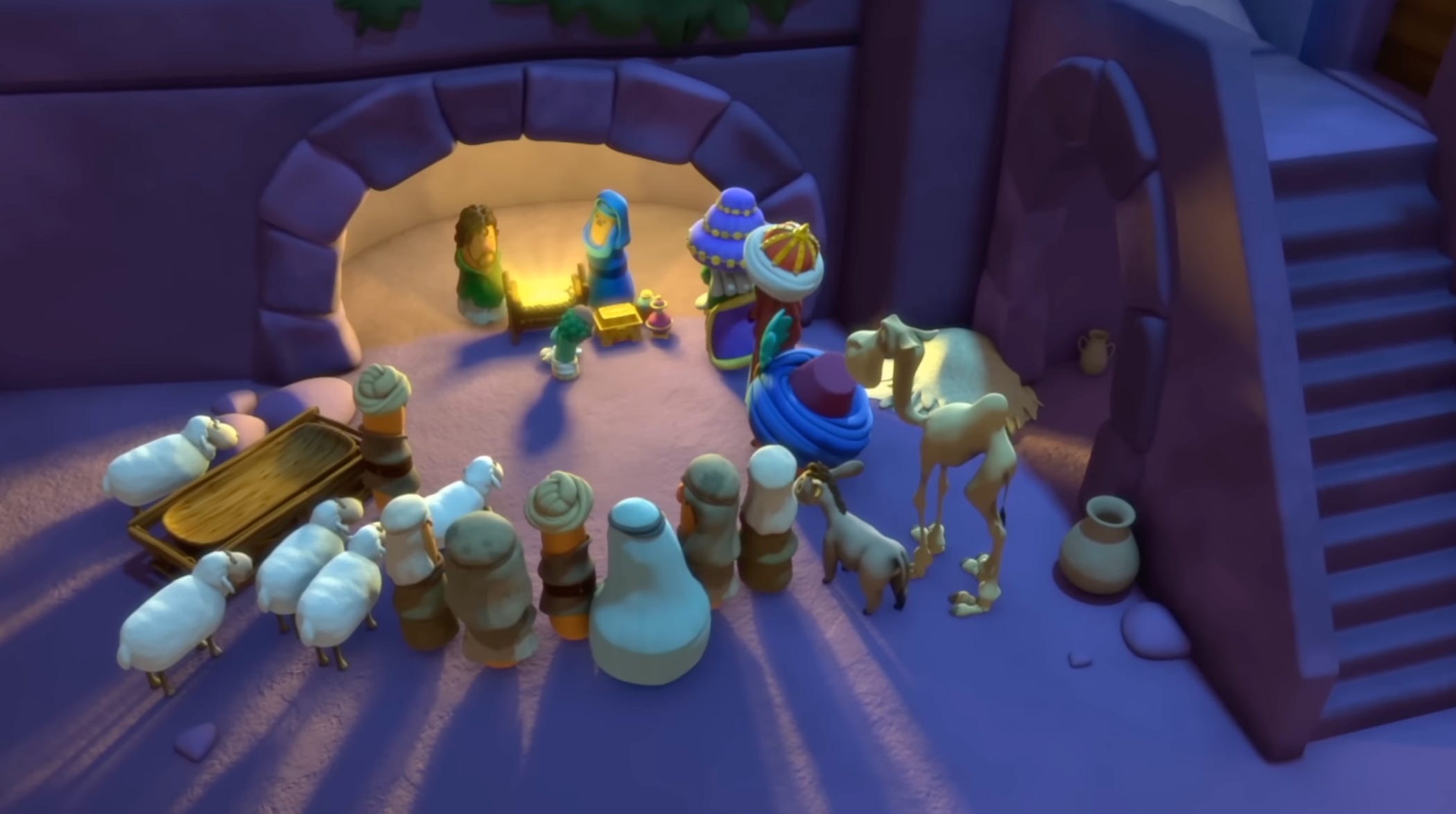
You can watch this segment on the VeggieTales YouTube channel and judge for yourself, but my verdict is: no, baby Jesus is not depicted as a vegetable in Little Drummer Boy.
The Star of Christmas (2002)
The 2002 episode, The Star of Christmas, isn’t quite as visually clear about this point, but it also seems to me like they’re depicting the manger without clearly showing baby Jesus as a vegetable:
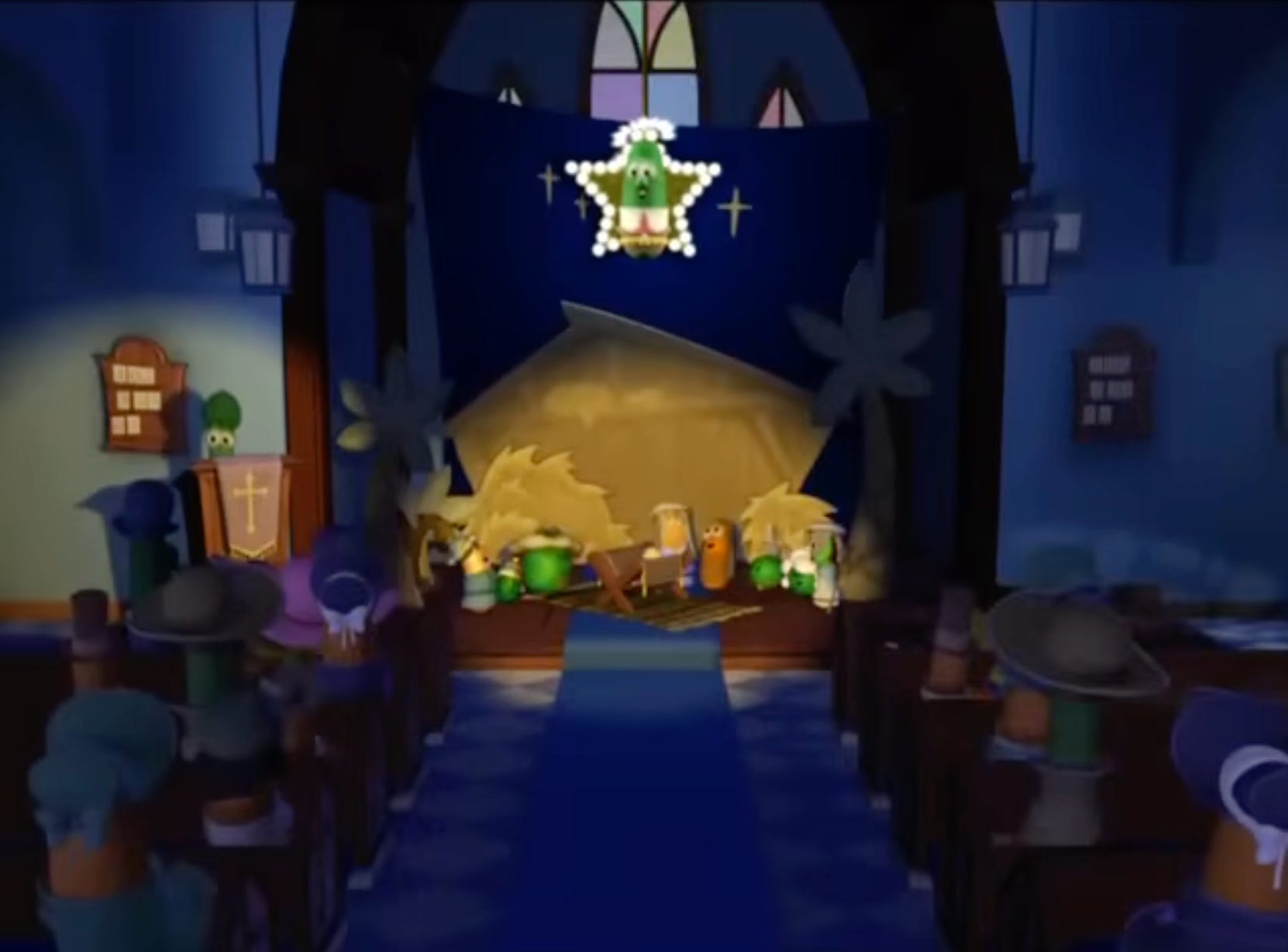
This moment from The Star of Christmas is also, interestingly, a play within a play within a play. There are 3 layers to this:
Bob Tomato and Larry Cucumber live on a kitchen counter in the present day
Bob, Larry, and friends dress up in 19th century attire and portray a tale set in historical London, where two thieves named Cavis and Milward (played by Bob Tomato and Larry Cucumber) try to steal the star of Christmas from St. Bart’s church
After Cavis and Milward see the error of their ways and learn about the true meaning of Christmas, the characters in 19th century London then put on a nativity play, where they portray the birth of Jesus at the start of the first century.
And within this “play within a play within a play,” we never actually see baby Jesus directly. We do see a baby-shaped form, but always wrapped in swaddling clothes that obscure our view:
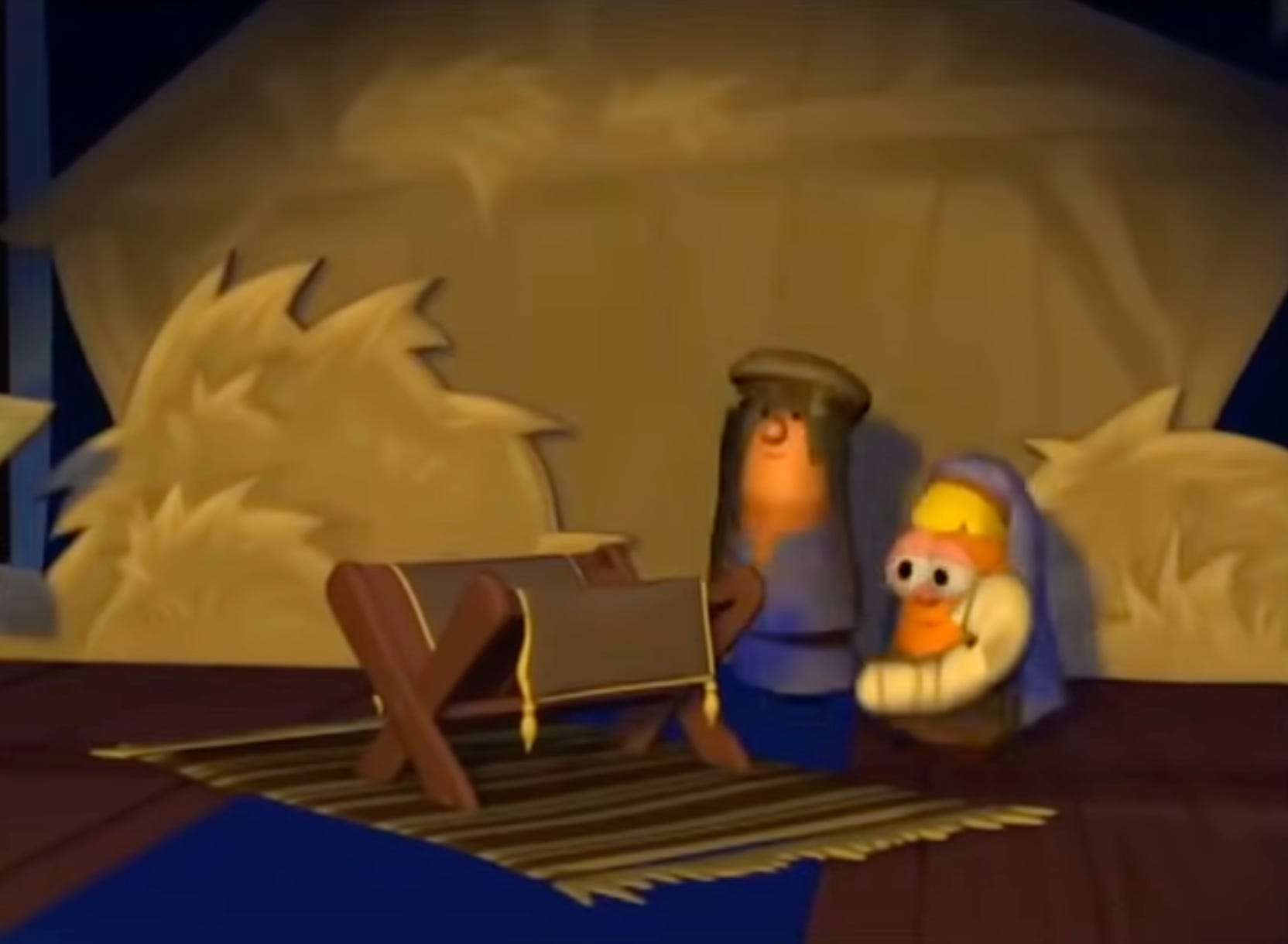
In fact, if we go to the bottom meta-fictional level, it doesn’t seem to me that baby Jesus is being portrayed by a baby vegetable in-universe: it seems more likely that what we are seeing is probably more like a doll, or some other appropriately baby-shaped prop, and judiciously hidden from the audience in every frame.
So, I don’t think that The Star of Christmas (2002) is breaking our “don’t depict Jesus as a vegetable” rule.
However, while the 2002 and 2011 Christmas episodes “play by the rules,” they do play a lot faster and looser in the 2017 and 2019 Christmas episodes. In case the significance of that date is lost on you, a brief digression:
VeggieTales, under new management
VeggieTales can be roughly divided into three “eras”:
“Classic Big Idea”: 1993–2015: the original VHS/DVD run where Bob and Larry are on the countertop, read a fan letter, and then deliver a story (often a Bible story) and Silly Song. This is “classic VeggieTales” as most people remember it.
Netflix/DreamWorks era, inclusive of both VeggieTales in the House (2014–2016), which ran for 4 seasons, 52 episodes, and VeggieTales in the City (2017), which ran for 2 seasons, 26 episodes. Each episode consists of two 12-minute segments.
The “2019 reboot,” released as The VeggieTales Show: more similar to the original VeggieTales in terms of framing device, visual style, and voice talent (Phil Vischer is back voicing most of the characters he’s famous for), but with different creative leadership.
(Separate from these, there was also a short-lived LarryBoy 2D-animated spinoff series.)
All of the episodes we’ve discussed so far (in both this post and the previous one) are from the original Big Idea VHS/DVD era. The eras that followed it are quite different:
The DreamWorks era
The DreamWorks/Netflix era, due to its many differences in format and visual style, is not something you would mistake for “original VeggieTales.” Instead of classic bible stories, we get segments that feel more like contemporary sitcom plots with a moral lesson.
For example, in Bacon and Ice Cream, Larry is an Ice Cream Junior Assistant who gets a chance to prove himself. (“Larry, if you train Bill, and show me you can pass work on to others, the cart is yours.”)
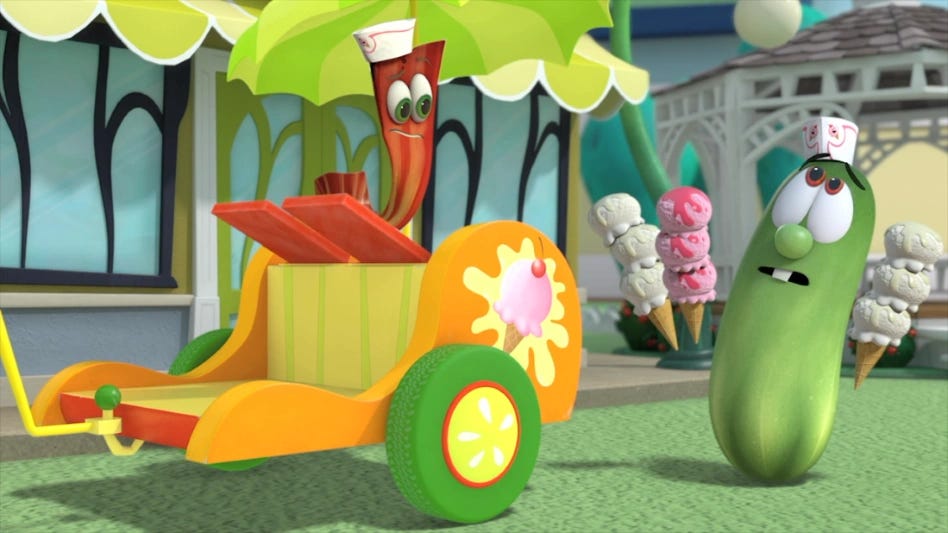
In Bacon and Ice Cream, Larry learns that you don’t earn responsibility by being the fastest “scoop king,” but by treating people well while you work, even if it might seem like the others are slowing you down. We get a lesson about leadership and the importance of being patient with people who are still learning.
I think it’s a fine moral message, and most Christian parents would be happy to endorse moral lesson being taught here. The DreamWorks era of VeggieTales is clearly compatible with Christian teaching. But watch the episode for yourself, and you’ll observe that this segment contains zero mentions of “God” and no explicit references to the bible.
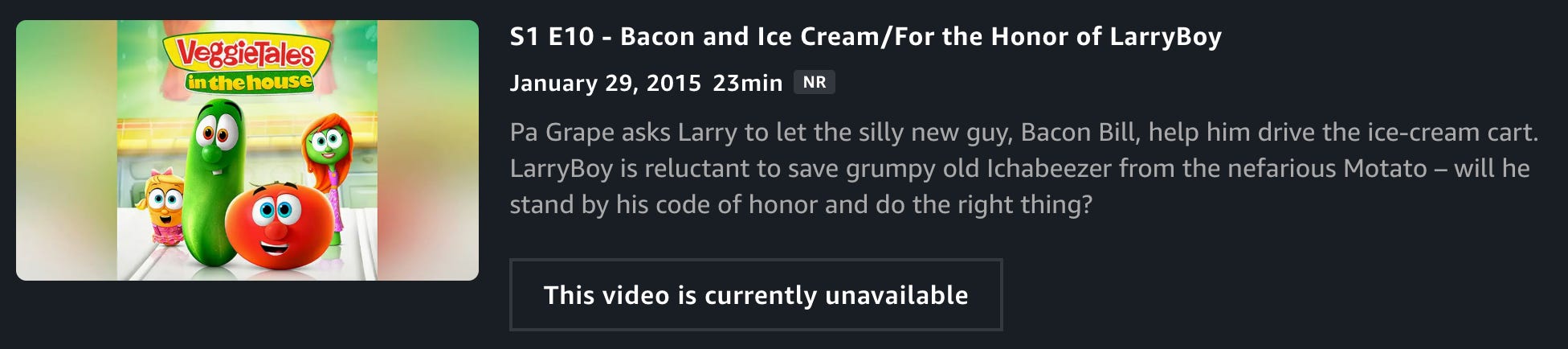
That’s not to say that God’s name is absent from every episode in the DreamWorks era. For example, in An Ichabeezer Christmas, someone asks Bob if he intend to gives to give a present to his Scrooge-like boss, and Bob responds “Of course! God loves him, so I love him too.” And God is sometimes acknowledged in the context of song, like in the birthday song from Two Birthdays:
We’ll shout “Hip hip hooray!” because we know it’s true
God designed one of a kind, there’s only one of you!
(Remember that Vischer’s #3 rule for the show was “as often as you can, remind kids how special they are, and how much God loves them.”)
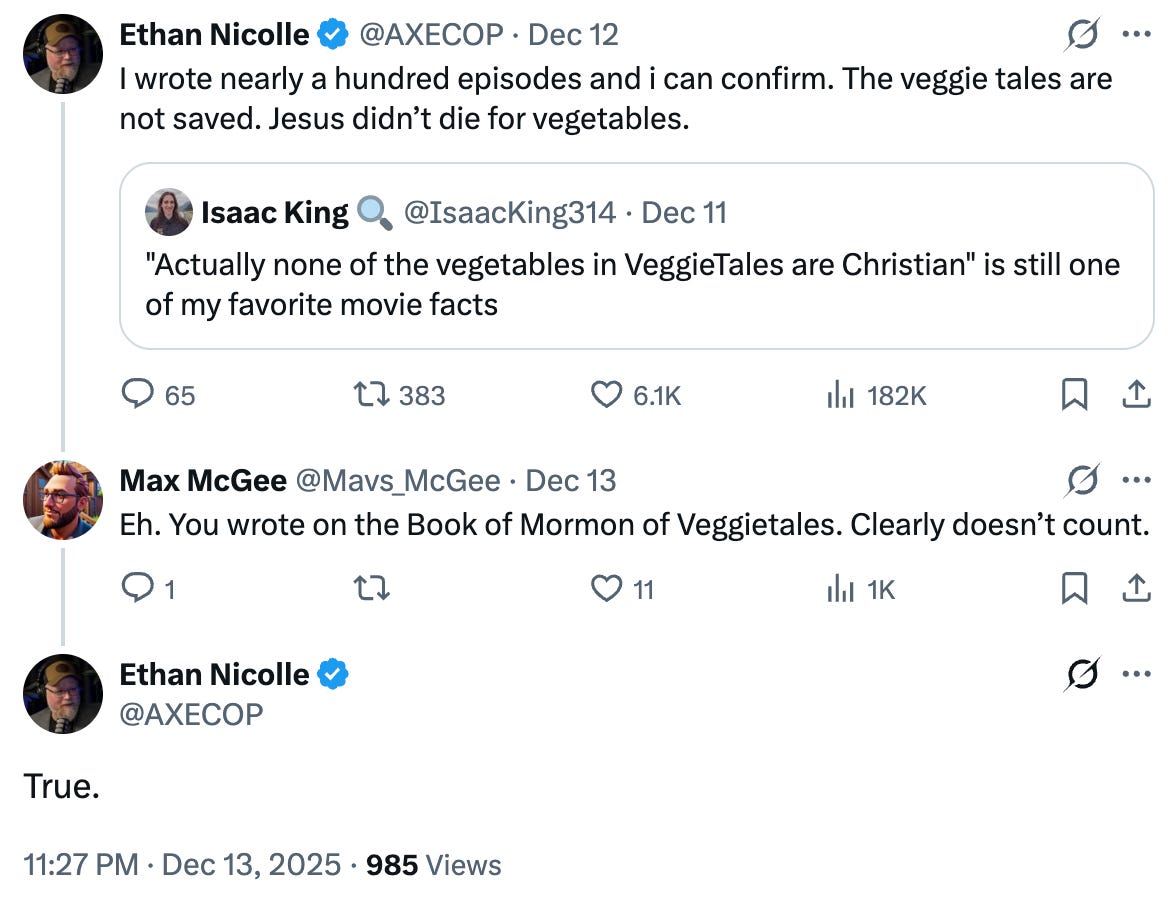
It should be noted that while many VeggieTales fans do not consider the Netflix/DreamWorks era to be “real VeggieTales,” and while Phil Vischer was replaced both as a creative lead and a voice talent, the Phil Vischer “rule” about how “Jesus didn’t die for vegetables” remained in place during those years, according VeggieTales in the House writer Ethan Nicolle:
But remember, we are here to settle the question of whether VeggieTales broke the rule that “you will not depict Jesus as a vegetable.” And while VeggieTales (1993–2015) did not break this rule, the Netflix/DreamWorks era VeggieTales in the House does have this moment, where a young asparagus plays the role of baby Jesus in the town Christmas pageant:
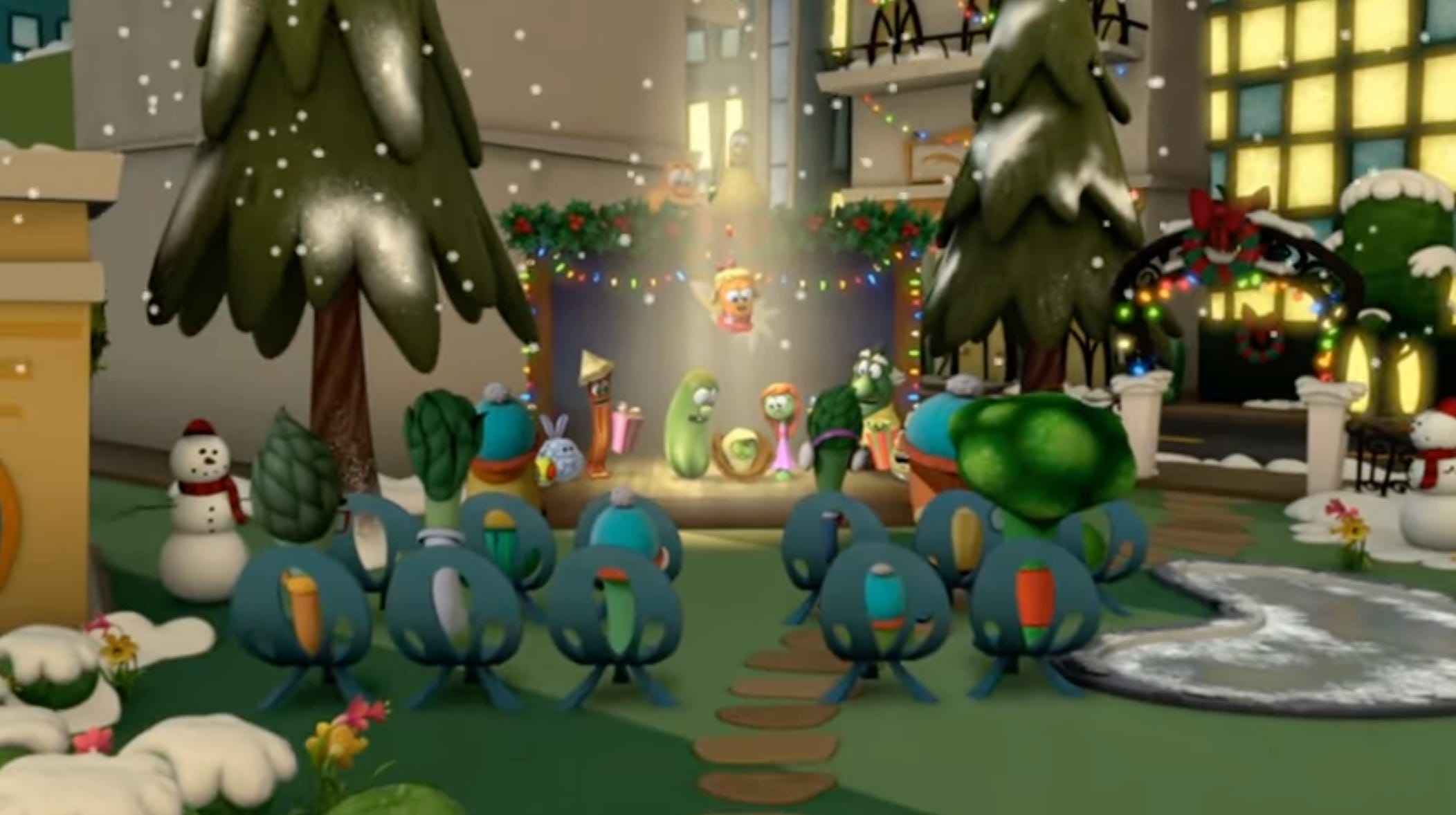
That being said, while this does clearly show the role of baby Jesus being portrayed by a vegetable, I do want to be charitable to VeggieTales in the House and say that this feels faithful to the spirit of the rule.
Much like the Star of Christmas (2002), the “story” of this episode is not the nativity story, but about a modern Christmas pageant where the characters act out the nativity story. The plot of this episode is not “Joseph and Mary travel to Bethlehem;” the plot of this episode is “a beleaguered Bob Tomato struggles to put on a low-budget Christmas Play where everything seems to be going wrong.”
I concede that this is cutting things a little thin. But I think the layer of separation is pretty clear here: we’re not intended to be fully immersed in the deepest layer of the fiction. Even children will not be confused by this image: they understand, “that’s not Joseph, that’s Larry Cucumber, pretending to be Joseph for the VeggieTales Christmas play!”
We don’t even see the vegetables “act out the nativity story” in full; all we get is an end-of-episode montage while Silent Night plays.
We see something similar in the 2019 reboot:
The VeggieTales Show (2019-2022)
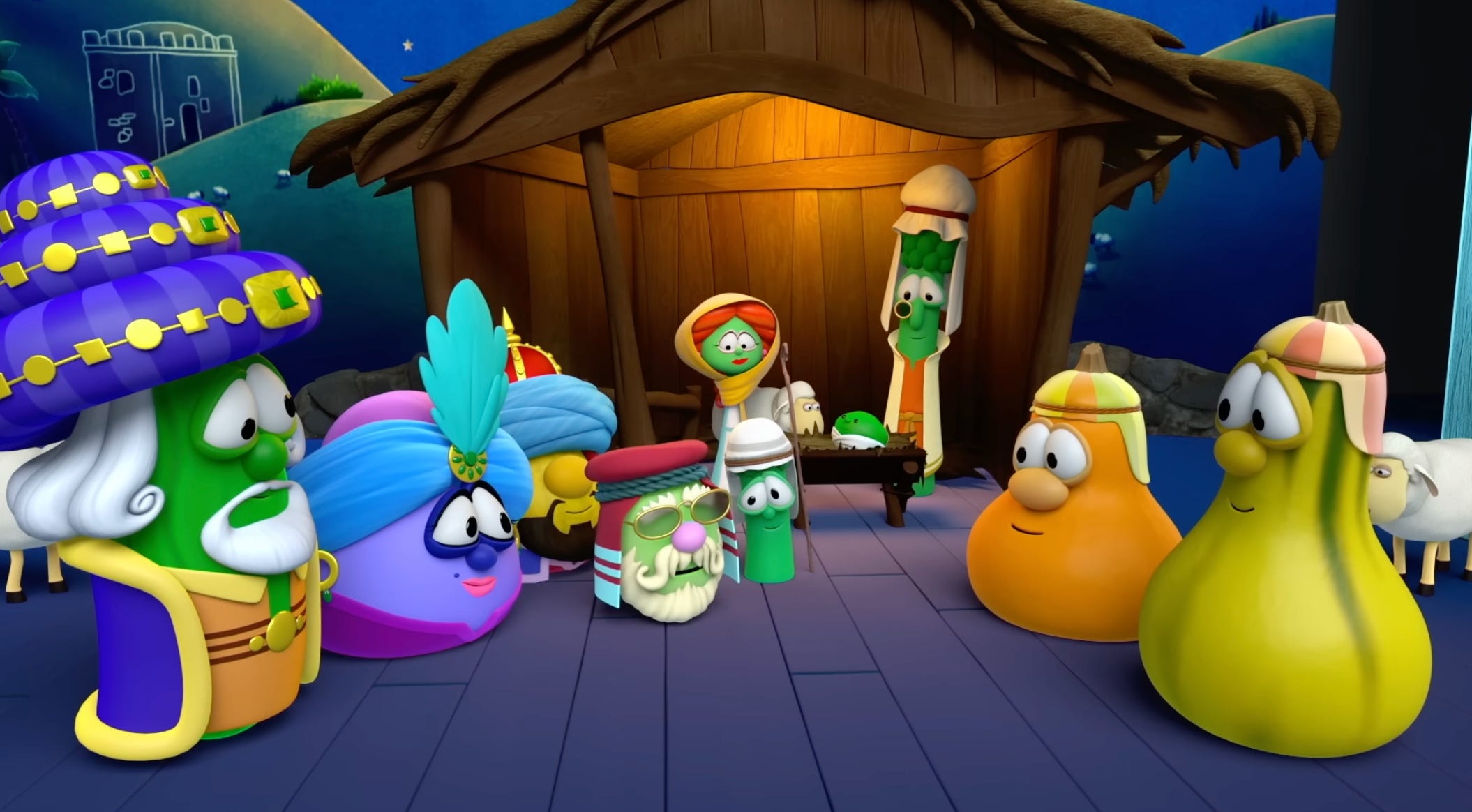
Once again, Bob Tomato is stressed out because it’s time for the annual Christmas pageant. And once again, we see a Christmas pageant production where the role of baby Jesus is played by a vegetable (in this case, one of the peas). And once again, the main level on which the fiction operates is “the vegetables are putting on a Christmas production.”

The show has all of the kitsch you’d associate with a real-world community Christmas play: the “angels” wear harnesses and are suspended from wires. Their “halos” are obvious props that are attached to their head.
In this 2019 episode, we do get a bit more “immersed” in the nativity story: there’s dialog that is spoken “in character” as the shepherds and wise men travel across the boards to see the newly-born Messiah in Bethlehem. But the literal set of the play serves as a constant visual reminder that “this is a play,” and when they’re done with their in-universe stage play, we get a shot of the audience as they applaud.
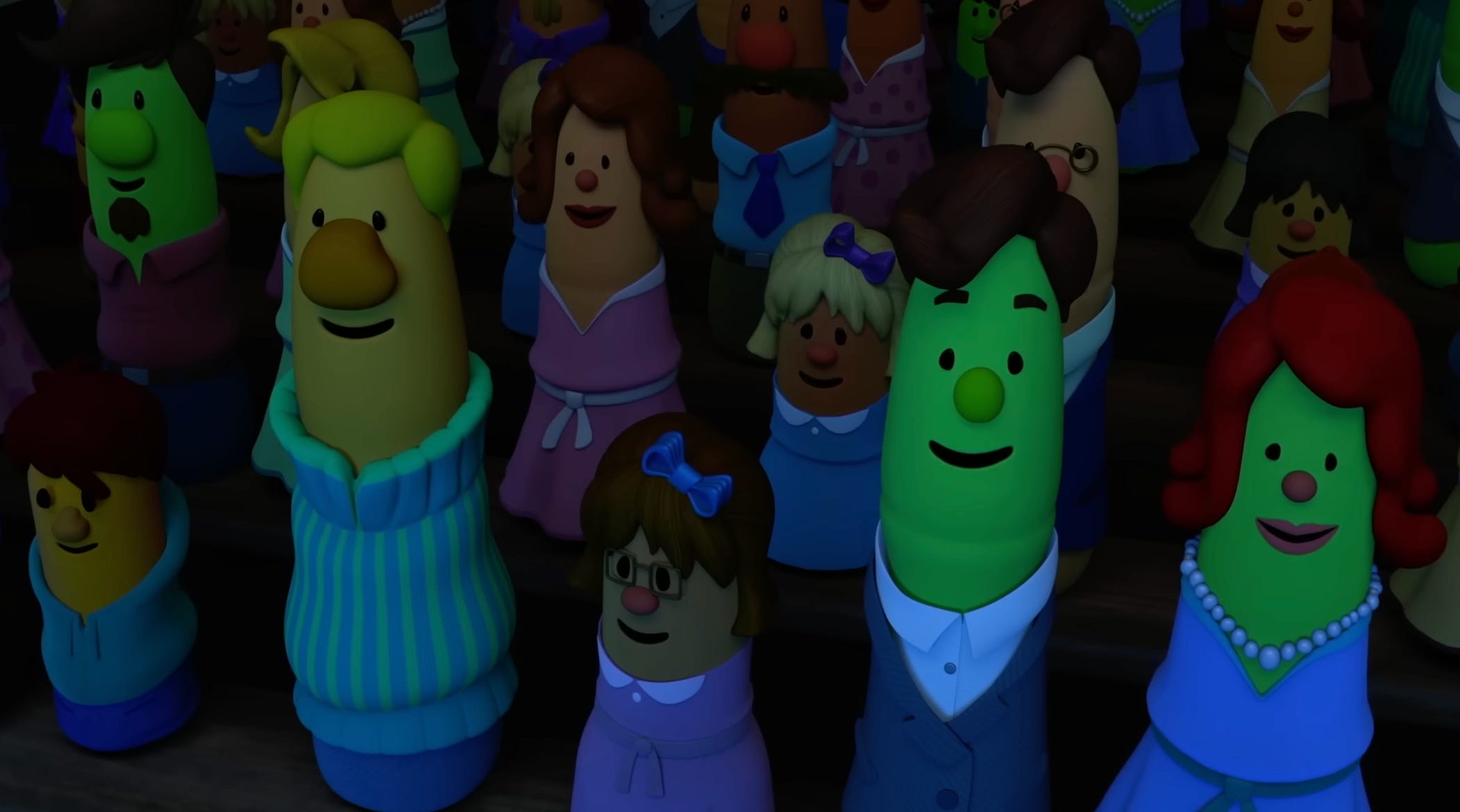
Again, this might be cutting it too thin for some people’s tastes, but this feels intentionally separate from the “bible story” format that VeggieTales usually sticks to.
(As an aside: The VeggieTales Show from 2019-2022 is more faithful to the original show in terms of appearance and format than the DreamWorks shows, but it had completely different creative leadership, and there are fans who still consider this to not be “real VeggieTales.” While original series co-creators Phil Vischer and Mike Nawrocki did return to reprise their original voice roles, they were not in the creative driver’s seat for this one.)
Did VeggieTales break the rule about depicting Jesus as a vegetable?
We can treat this as three separate questions:
Did VeggieTales (1993-2015) ever depict Jesus as a vegetable? No.
Did the DreamWorks run of VeggieTales in the House / VeggieTales in the City ever depict Jesus as a vegetable? Sort of, if you consider the in-universe Christmas pageant to be breaking this rule.
Did The VeggieTales Show (2019-2022) ever depict Jesus as a vegetable? Same answer: sort of, if you consider the in-universe Christmas pageant to be breaking this rule.
Does it matter?
I think the question of “did they stay true to the spirit of the rule” is a lot more salient here than the question of whether they were true to the most literal reading of the rule. The Phil Vischer rule was:
“Rule number one, you will not portray Jesus as a vegetable.”
Why did this rule matter? I can only speculate about the exact reasons they formulated this rule, but I think it would be hard to approach the character of Jesus with an appropriate level of reverence in what is fundamentally a comedy series. If Jesus is vegetable, then Jesus becomes part of the comic universe, available to be silly and “played with” in a way that feels inappropriate. You can have an asparagus play David and gourd play Goliath because David and Goliath are fair game for comedy in a way that God incarnate isn’t.
There’s also the problem of “putting words in Jesus’s mouth.” When Larry Cucumber plays Joshua, the writers can take some liberties, make him funny, and give him anachronistic dialogue. But when you write lines for Jesus, that carries a lot more weight. Some shows like The Chosen (2017) do choose to carry that weight, but VeggieTales wanted to be a comedy for kids.

When VeggieTales depicts baby Jesus in the manger, they obviously sidestep the issue of “putting words in Jesus’s mouth.” And I also think that A Christmas Play (2017) and The Best Christmas Gift (2019) are appropriately reverent when it comes to the moments that depict baby Jesus.
Both of these episodes have plenty of jokes, but during the moments that baby Jesus is on screen, the joking stops. In A Christmas Play, all we hear during the moments when baby Jesus appears on screen is the vegetables singing Silent Night.
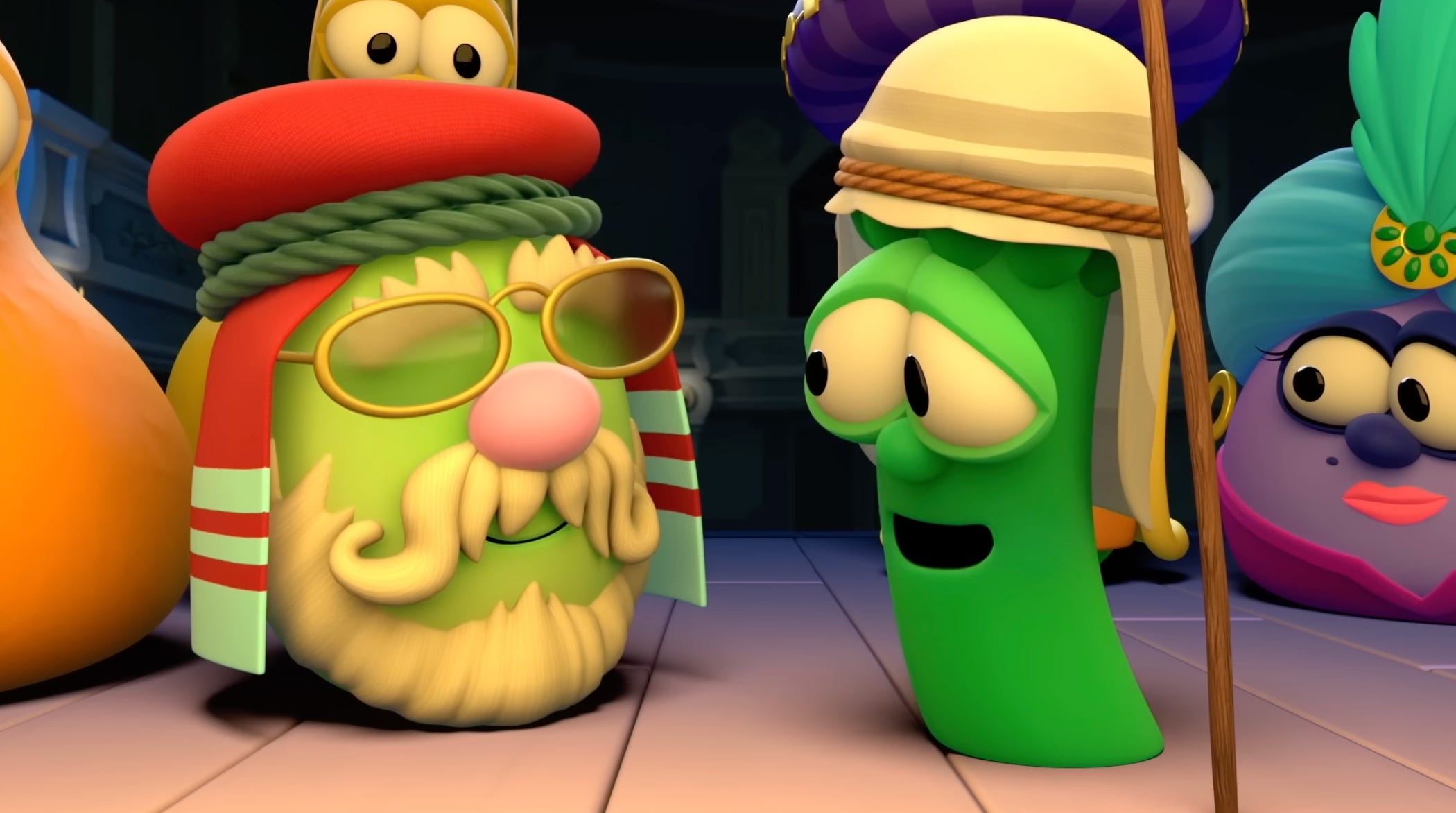
And in The Best Christmas Gift, we get dialog that is obviously “written for kids,” but that dialog feels appropriately reverent, devoid of any jokes or quips:
Junior: The world is broken?
Pa: Yup. By sin.
Junior: And sin is?
Pa: When we put ourselves first. When we say, “I’m not gonna listen to God. I’m gonna do things my way.” Sin has broken the whole world. And the Messiah is coming to make it right. To fix it. To heal everything.
Junior: Whoa. But how can one person do that?
Pa: Because that baby in there, that baby isn’t just a person. That baby is also God. And he has the power to heal everything.
Junior: He can make all the bad go away?
Pa: This is just the beginning. The Kingdom of God is here. That baby will grow up to heal people, to make blind people see and lame people walk, to show us what life is like when all the bad stuff is wiped away. And we can join him. We can help spread the Kingdom of God. And then one day, when it is time, God will set everything right.
Junior: This baby will make all the bad go away. He’ll bring the Kingdom of God. And I can be a part of it!
Pa: The promise of Christmas is God with us in the bad times, and God with us to end the bad times. The Kingdom of God is here. And we can all be a part of it.
Merry Christmas!
This post was written as a follow-up to last week’s post:

Thanks for this, it realy clarifies things! What about future sentient AIs? So insightful!
Anyone else remember having a VeggieTales nativity set as toys? Cuz i remember having one that i believe was from the star of Christmas movie, and it definitely had a baby Jesus in it. I get that toys are kinda out of the realm of the same rules....